

A glimpse into a personal tragedy sometimes gives us a picture of terrible human possibility writ large. Painful but necessary, such lessons are our only hope of preventing future carnage. That is why the fourth annual Fellowship and Summer Institute on Antisemitism and Jewish Identity in Educational Settings hosted a compelling Holocaust survivor.
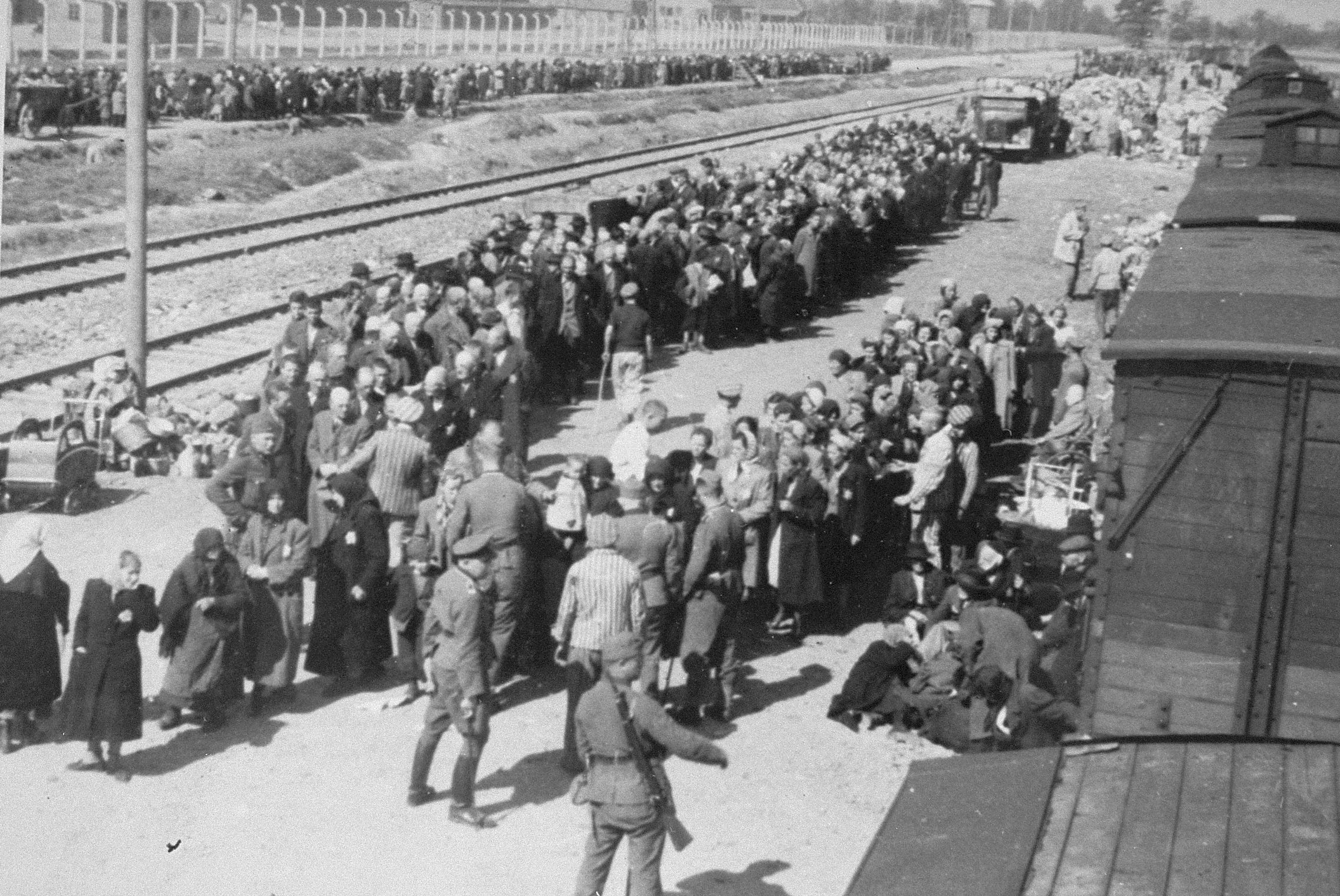
Irene Weiss is 95 years old. A photograph of her, taken 82 years ago, documents what would become the worst day of her life. For decades, Irene did not know that a Nazi photographer shot the image in the spring of 1944, on the arrival ramp at Birkenau, the killing center within Auschwitz. Decades later, her daughter found it in a published album.
In the image, a 13-year-old girl in a headscarf leans forward, searching the crowd for her younger sister, Edith. The sister was already gone, moving with the column bound for the gas chambers.
Listening to her this week at George Washington University, I kept returning to one fact: in 2024, I stood on that ground. Auschwitz-Birkenau lies about 90 minutes outside Krakow. I walked the platform where Nazi soldiers sorted people. A man with a baton decided instantly who would work and who would die. I had read about the place, but witnessing it brought a different order of knowledge.
Now, two years later, I sat in a room and listened to a woman who had been a child on that exact site.
More than 400,000 Hungarian Jews were deported by train to Auschwitz over a matter of weeks in 1944. Irene’s entire family was among them, fed into a killing-and-slave-labor operation that wiped out most. Her father was forced to move bodies and perform other labor as a Sonderkommando; he was shot as soon as he could no longer do the work. Irene’s mother and three younger siblings were murdered upon arrival. Only her sister Serena joined her among the survivors.
Irene and Serena were assigned to the section the prisoners called Kanada, where the belongings of the murdered were sorted and stored: the suitcases, the shoes, the eyeglasses, the photographs of families. For eight months, Irene handled what was left of the dead. She spoke about cruelty as something she had been made to study at close range, and she questioned not only the camp but the civilization that made it possible. How could it happen, she asked, in the heart of the modern West?
My own conclusion, not hers, is that civilization can break down, and barbarism is closer than we imagine. The same progress that laid track across a continent laid the track to Auschwitz-Birkenau. If it could happen once, it could happen again.
The officers who ran Birkenau’s human-sorting center decided who was old enough and strong enough to work. The rest were exterminated. Irene believes that her scarf saved her life. After her head had been shaved in the Munkács ghetto, her mother had given her the cloth; it made her look older than her 13 years—old enough to work.
That is why she survived; dissociation is how she survived. Irene moved through her captivity as though she were on another planet, as though she were watching the experience from outside her own body. Some realities are too terrible to endure in any other way.
For those of us who heard her story, the experience was just the opposite. Connecting our learned history to her lived experience rehumanized the scene: a child on a platform, delivered to the macabre scene of loss, misery, and endurance against all odds. Her job is to keep reminding us of the terrible possibilities; our job is to listen and believe her.
I am grateful to Irene Weiss’s daughter, Ilana, for confirming the photograph, and to Naomi Gamoran for her help.
Jews from Subcarpathian Rus undergo a selection on the ramp at Auschwitz-Birkenau, May 1944. Irene Fogel (later Weiss), age thirteen, is in the front row, second from left, facing forward. From the Auschwitz Album, photographed by SS-Hauptscharführer Bernhardt Walter and his assistant SS-Unterscharführer Ernst Hofmann of the Erkennungsdienst (Identification Service). United States Holocaust Memorial Museum, courtesy of Yad Vashem (Public Domain), Source Record ID FA 268/026.
Such an atrocity ... & I agree, we could slip back t this level of inhumanity again &it scares me!