

How my mother’s ancestors traveled from Israel to Persia remains a mystery. My aunt Nasreen insists we trace back to the Jews expelled from Spain in 1492. Whether this is a true memory or a myth, it persisted. In a life where so much had been erased, even a legend was a form of solid ground.
What we know for certain is less romantic. My maternal grandfather was born a Gabaï. During one of Iran’s periodic waves of antisemitism, he traded that name for Farahmandpur. He surrendered a heritage to buy safety. These name changes were small, quiet erasures—shields used against threats they could neither confront nor escape.
“Gabaï” is Hebrew for those who tend to a synagogue and its people. And there, eight kilometers from Granada, the city once known as Garnāta al-Yahūd, “Granada of the Jews,” sits a town called Gabia. When the Catholic Monarchs expelled the Jews in 1492, thousands scattered east across the Mediterranean into Ottoman lands. Did some branch of my family begin there, drifting through centuries and empires until they reached Iran? Or is the resemblance between Gabaï and Gabia just a mirage? Each possibility felt like a door opening onto a past I could sense but never quite grasp.
Years later, in the salt-heavy air of Antibes, I wandered through narrow lanes under a pale gold sky. A gull cried over the tiled rooftops. Then, in the window of the Gabaï Frères furniture store, a single word stopped me.
Gabaï. Sun-faded in the window. My grandfather’s buried name.
Inside, the scent of waxed wood mixed with memory. The shopkeeper, a kind man with silver hair, greeted me. His grandson translated as I explained that my grandfather had been forced to bury that same name a world away. The old man’s eyes brightened. He pressed a business card and a Gabaï-stamped keychain into my palm.
“Family finds family,” he said through the boy, “even after the long journeys.”

Was he a relative? A fellow descendant of exiles? I will never know. But I felt a strange pulse of relief as I turned the keychain over. It was a name that had refused to vanish, no matter how deep it had been forced into the shadows.
My father’s side holds a story just as layered. His parents were Kurdish Jews from Kermanshah who claimed descent from the tribe of Benjamin. They, too, abandoned their original surname, Hebroni, and chose Farahmandpur. There is a strange irony in the translation: “descendants of a happy people.” Two distinct lineages—perhaps Sephardic, certainly Kurdish—folded beneath the same Persian pseudonym. Two acts of survival becoming one family legacy.
These were not abstractions; they were answers to real danger.
One story survives from my maternal grandfather’s side. His younger brother, Sinoor, lived in Golpayegan, a conservative town south of Tehran. In the early 1940s, as he walked toward the bazaar, a young cleric stepped forward and slapped him across the face without a word.
The sound landed with finality.
Sinoor did not protest. At the time, Jews were often forbidden from sharing the same walkway as Muslims. That cleric was a frequent visitor from the nearby town of Khomein.
His name was Ruhollah Khomeini.
Sinoor died young of an unexplained illness, but the humiliation of that slap endured, passed down like a physical scar. When that same cleric rose to power decades later, the story became prophecy rather than history.
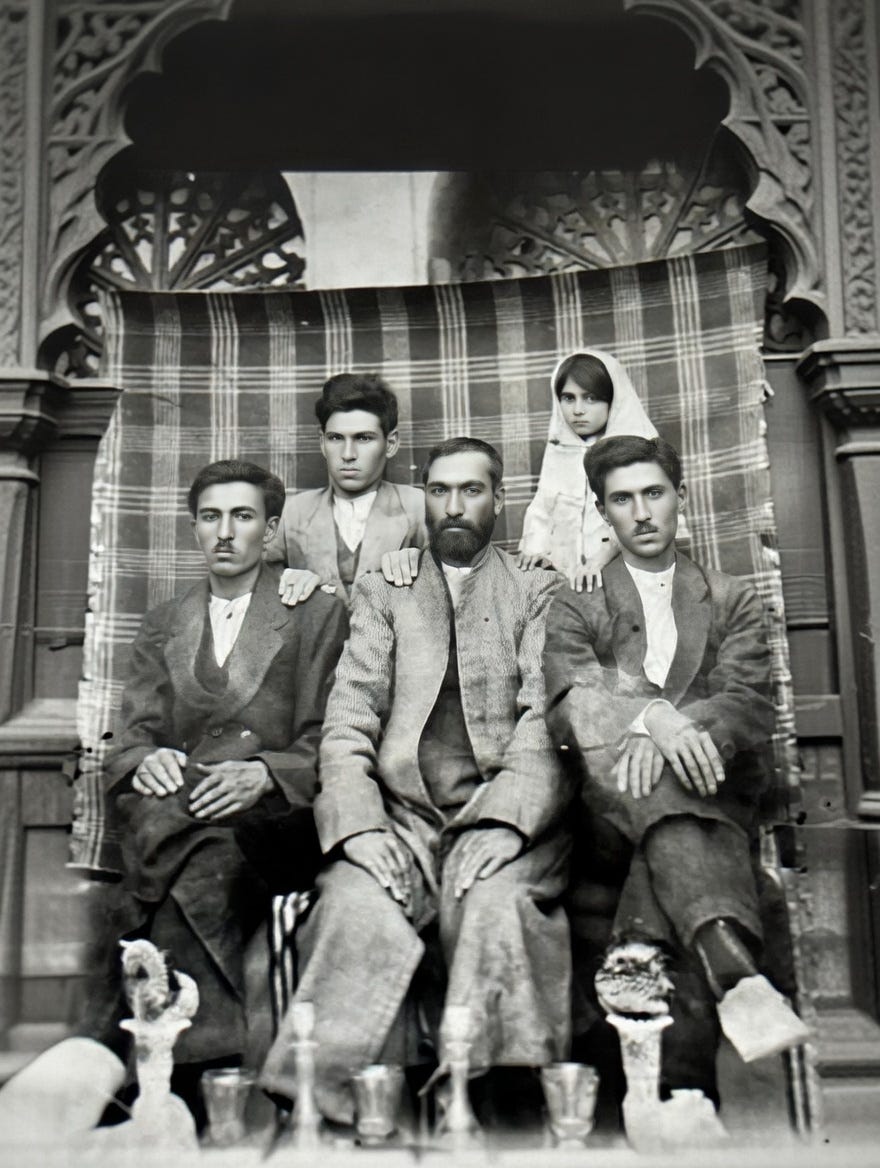
As a young person in revolutionary Iran, I repeated what my ancestors had practiced for centuries: I became smaller, quieter, harder to see.
If the Spanish story is true, my ancestors may have been among those who outwardly converted while lighting Shabbat candles in secret. My Kurdish ancestors paid the jizya tax and kept their heads down. They were Farahmandpur for the world, but Hebroni and Gabaï in the dark.
Now, my generation continues the transit. The current of diaspora runs through time, unbroken.
In that shop in Antibes, a name I had only heard whispered was pressed into my open hand. It had traveled further than I could ever trace.
I closed my fingers around it and didn’t let go.
Academic Gadfly usually looks at how institutions erase what they can't control. This is where that question started for me: in the names my family buried to survive.