

By 1983, Tehran felt brittle, as if one more shock could split the city open. Prices climbed faster than anyone could track. People vanished. Conversations grew terse, and silences held their own warning. Daily life stretched taut; nerves frayed.
One afternoon, I bent over my homework, letting the scratch of my pencil ground me. Briefly, the world felt orderly. Then a scream tore through the alley.
I froze. In those days, a shout could mean anything. I ran for the door and flung it open.
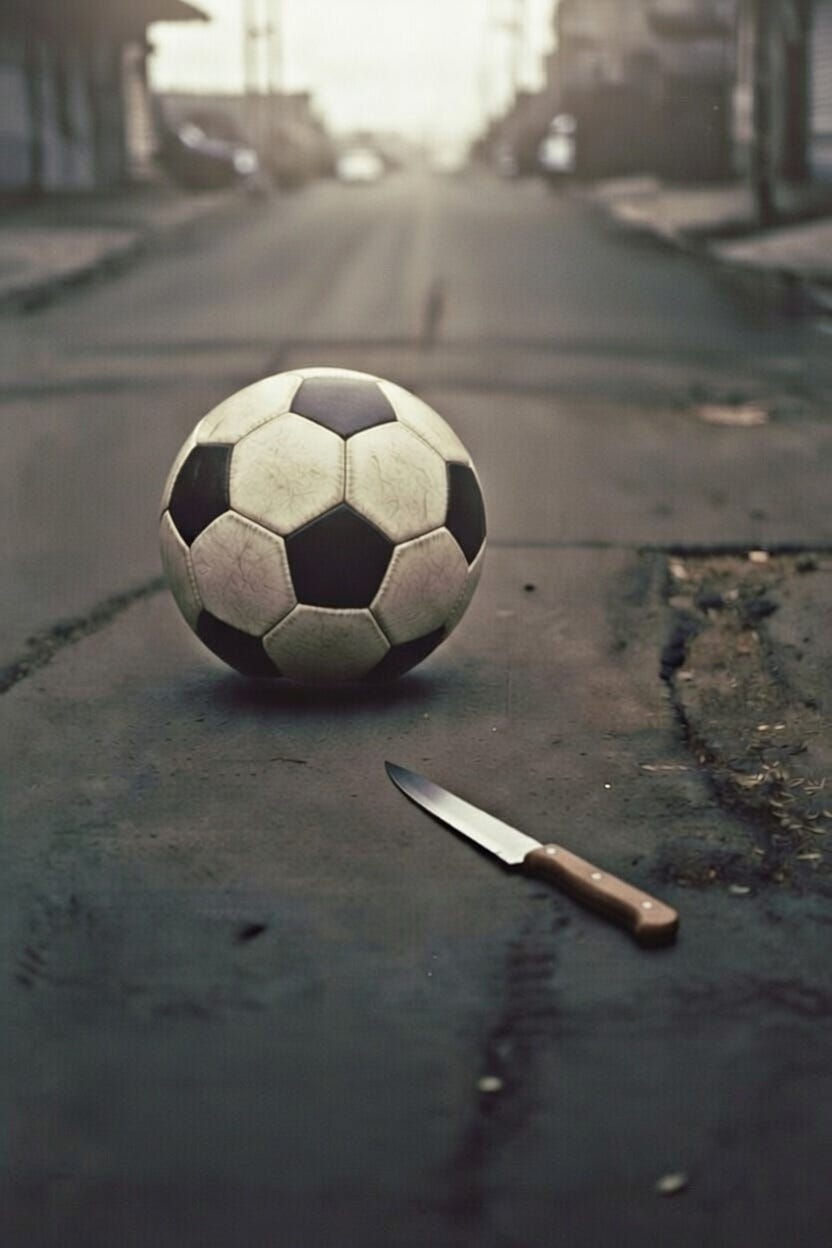
The alley erupted. Four men wrestled in the dust, their bodies tangled in panic. In the center was Hassan, a mild-mannered man I had only ever nodded to, with a kitchen knife clutched in his hand. My father was among the men trying to restrain him, sweat streaking his brow. Around them, twenty neighbors stood frozen.
“Let me go!” Hassan shouted, shaking with fury.
“Drop the knife,” my father said. He trembled, but he didn’t step back.
“I’ll kill that kid!” Hassan cried.
The boy—Mohsin, barely ten—clung to his mother’s clothes while two neighbors shielded him. Hassan’s wife pushed through the crowd, sobbing. “Please, Hassan. For God’s sake, put it down.”
Hassan’s breathing was ragged. “That ball,” he choked out. “Every day, the bouncing. It’s driving me insane.”
But the ball wasn’t the reason. All of us knew that: the ration lines, the martyrs’ posters, the knock at midnight.
“He’s only a child,” someone said.
“I can’t take it anymore,” Hassan sobbed. “I can’t.”
My father lunged with Mr. Ebrahimi and another neighbor. They forced Hassan’s arm down. My father pinned his wrist with his boot. No one dared breathe. One slip and blood would spill. My mother stood behind our window, her face pale, begging my father with her eyes to be careful.
He didn’t move until the knife was finally torn from Hassan’s grip.
Hassan collapsed, sobbing. Two buttons were missing from his shirt. His threadbare undershirt clung to his back as he pressed his face into his knees. His wife knelt beside him, holding him like a child.
“I just wanted some peace,” he murmured.
Peace no longer existed. Revolutionary Iran had stripped it from our homes and streets. Mohsin’s mother stepped forward. Her voice was flat. “You almost killed my son.”
Hassan looked up at her, stunned, only now registering where he stood. His wife helped him to his feet. He appeared suddenly older, worn down by forces none of us dared name out loud.
The crowd dispersed, neighbors slipping into their homes, closing doors, whispering behind paper walls. My father lingered, trading a few words with the men, his shoulders sagging. My mother leaned into the wall and let out a long breath.
No one had been hurt. No one had died. Not this time.
I sat again at my desk, but the world felt too loud: the scratch of my pencil, a vendor shouting in the street, a radio blaring an anthem full of promises no one believed anymore.
The alley had revealed how close any of us were to breaking. It wasn’t the noise that drove Hassan to the edge. It was everything the city had piled onto him—onto all of us. His knife was never meant for a child. In those years, even ordinary sounds meant danger, and even ordinary mistakes brought consequences.
Our walls held both lessons tightly: thin as paper, loud as a knock at midnight.
While this excerpt steps outside higher education, it speaks to the very conditions that drive displacement and migration, and to the lived experiences many of our students bring into the classroom. The forces that drove Hassan to his breaking point have not disappeared; they have compounded across four decades of sanctions, war, and authoritarian control. What I witnessed in that Tehran alley is what millions of Iranians still endure, because the regime changes its tactics, but the pattern holds.