

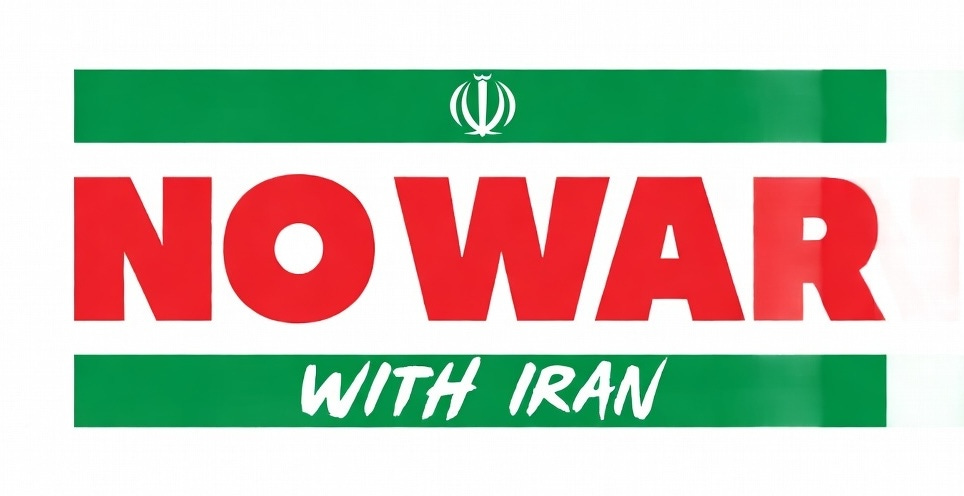
A local activist has been sharing a sheet of bumper stickers. Bold red letters against green and white stripes read: NO WAR WITH IRAN. But centered in the green stripe at the top of each was the emblem of the Islamic Republic of Iran—the stylized calligraphic sword and crescents adopted after 1979. As someone whose community bears the scars of the regime that emblem represents, the dissonance was immediate. The anti-war sentiment is one I share deeply. That emblem is not a neutral symbol.
The Two Orders of Meaning
Roland Barthes published Mythologies in 1957 as a series of short essays on what everyday objects are made to mean: a wrestling match, a detergent advertisement, a glass of red wine. His central argument was that the cultural meanings embedded in everyday objects appear natural but, on closer inspection, are always constructed. Semiotics, the study of signs, was his method of reading these objects.
Barthes drew on the work of Swiss linguist Ferdinand de Saussure: every sign consists of a signifier (the visible or audible form) joined to a signified (the concept it conveys). But where Saussure saw a static map of language, Barthes saw a political one. In what he termed myth, a sign already carrying meaning becomes the signifier of an entirely new, second-order message. The first meaning doesn’t disappear. The original meaning recedes, overtaken by a political or cultural one, while retaining just enough of its original content to seem natural, innocent, beyond argument.
His most famous illustration is a Paris Match cover from July 1955 showing a young Black French soldier saluting the tricolor. At the first order, the image is simply documentary: a soldier in uniform, a flag, a salute. These are the raw signs—each with a clear, literal meaning. At the second order, a deeper look reveals that the photograph carries a second message—one that signifies French imperial legitimacy. The soldier’s race is not incidental. It is precisely what the second-order message requires. His salute naturalizes the empire by making it appear multiracial, voluntary, and therefore just. The photograph makes no argument. It presents.
The Emblem at the Center
The “No War With Iran” sticker works on the same two orders.
At the first order, the sticker is legible: green, white, and red stripes evoke the Iranian flag; the emblem identifies the Islamic Republic as a state entity; the words announce an anti-militarist position. Each element carries a clear, literal meaning. At the second order, the sticker means something else entirely. The assembled sign—flag colors, state emblem, anti-war message—fuses into a single, apparently obvious meaning: Iran is a unified nation deserving of protection, and its proper symbol is the Islamic Republic’s own iconography. The emblem, which at first simply identifies a government, now naturalizes the Islamic Republic as the uncontested representative of the Iranian people.
The emblem’s symbolism makes no explicit claim that the regime is legitimate. By using the regime’s emblem as the visual anchor for Iranian identity, it presents the equivalence of state and nation as though it required no justification—as geography rather than politics, as description rather than construction.
One might object. Surely this is over-reading a bumper sticker. Isn’t it more likely that a well-intentioned graphic designer simply grabbed the first clip-art flag they could find? Yes, almost certainly. But for Barthes, the absence of intentionality is precisely the point. Myth is most effective when reproduced unconsciously. The fact that a progressive activist can deploy the insignia of a repressive state as a generic symbol of peace shows how uncritically the regime’s emblem circulates in Western anti-war spaces—not through conspiracy, but through the ordinary workings of myth.
The Islamic Republic is a historically specific political formation, born of the upheaval of 1979 and contested within Iran ever since. The choice to represent “Iran” through its emblem is a political act that erases forty-five years of internal struggle: the Green Movement of 2009, the recurring labor uprisings, the sustained and brutally suppressed Women, Life, Freedom movement of 2022, in which young Iranians died in the streets for the right to exist on their own terms. In this way, a political choice appears as a description.
The Unwitting Messenger
The Islamic Republic has long deployed its own sophisticated mythology—one in which the state and the nation are identical, in which criticism of the government constitutes betrayal of Iran itself, and in which the perpetual threat of foreign aggression serves to delegitimize internal opposition. Every dissident can be reframed as a foreign agent. Every protest can be recast as imperialism from within. The symbolism of the emblem is not neutral. For millions of Iranians, it is the insignia of a government that has imprisoned, tortured, and executed its own citizens for the better part of five decades.
The sign’s use of the Islamic Republic’s emblem, whatever its intentions, and I do not doubt they are humanitarian, reproduces the Islamic Republic’s own mythological structure from the outside. It accepts the regime’s framing: that Iran equals the Islamic Republic, that the emblem speaks for the people, that solidarity with Iranians means, at a minimum, treating the state as their legitimate representative. In doing so, it imports the regime’s framing into progressive Western political discourse, where it arrives wrapped in the righteous language of anti-imperialism and peace.
Barthes called this the alibi. Every myth needs one. As an alibi, it has force: there are bombs, and civilians who would die under them. But the alibi also forecloses further inquiry. Anyone who questions the symbolism of the emblem is accused of warmongering. Anyone who distinguishes between the Iranian people and the Iranian state is told that distinctions are a distraction when the bombs are already being loaded. In this way, the critique of the symbol is made to appear morally suspect. That suspicion is not entirely without foundation. Progressives know that nuance about Iran has historically been weaponized by hawks to manufacture consent for military intervention. But using the regime’s emblem to foreclose that nuance doesn’t prevent war. It simply sacrifices Iranian dissidents on the altar of Western ideological clarity.
The False Choice
For those who left because of that emblem, the alibi lands differently.
Iranian exiles do not speak with one voice on this—but many who left precisely because of what that emblem represents find themselves in a painful position when Western progressives adopt the Islamic Republic’s iconography as the symbol of Iranian identity. It forces a false choice: either accept the regime’s self-representation, or be accused of enabling the very war you also oppose. The person who opposes both the bombs and the government has nowhere to stand. To criticize the regime’s emblem is to be accused of enabling the war, given that foreign bombs would rescue the regime from its own internal reckoning.
It plays out at rallies, in coalition spaces, in the comment sections of well-meaning organizations, wherever Iranians try to say: we are against this war and we are against this regime, and these positions are not in tension. The response is often silence, suspicion, or the suggestion that now is not the time. The myth polices debate.
For those who lived that history, the sticker does not read as a sign of solidarity. It reads as burial—a people’s history silenced by the very symbol used to oppress them. The emblem has a history. It is the insignia under which people were imprisoned, executed, and driven into exile. Using it as a peace symbol does not sanitize this fact.
Seeing Iranians
Barthes held no illusions about myth’s reach. In the concluding essay of Mythologies, he acknowledged that all political signs naturalize their own assumptions. The task is not to find a language purified of ideology—no such language exists. The goal is to make visible what myth hides: that every apparently natural image has a history, a politics, a set of choices behind it.
A counter-mythological version of this sticker might retain the anti-war message while refusing the regime’s iconography, perhaps by using the plain green, white, and red tricolor stripped of any state emblem, or the specific green that became the color of the Woman, Life, Freedom uprising, or simply the words themselves, unaccompanied by any state symbol. Such a sticker would still say no to war but would hold open, in the very form of the sign, the distinction the original forecloses: that solidarity with a people does not require treating their government as legitimate.
For many Iranians, that distinction is critical. It is the difference between a politics that sees Iranians and a politics that merely sees Iran; between opposing the bombs that might fall from outside and acknowledging the violence that has been perpetrated from within for decades. Opposing both is not a contradiction. It is in solidarity with the Iranian people.