

The first time I saw Bruce Leimsidor, I did not know who he was. I was a frightened teenager passing through the Hebrew Immigrant Aid Society (HIAS) office in Vienna in 1985, one file among thousands, and he was the tall American attorney who directed the office. More than thirty years later, I found him again, this time in a photograph.
In 2017, I was searching the Center for Jewish History’s online archive of the HIAS Vienna office, looking for my own file. It turned up misspelled, beside a case number and an arrival date. In the same records, I came upon a black-and-white photograph of a man in his forties. On the back, someone had written his name. By then, of the people who had helped me escape, all I had left was a number in a worn address book and a face I could not remember. Here, at last, was one of them.
He had devoted his life to the rescue of the displaced, and he had done it nearly everywhere. Vienna came first: he directed the Central European office of the Hebrew Immigrant Aid Society, and later oversaw the U.S. State Department’s refugee-processing office in the same city. Nairobi came next, where he was a senior resettlement expert for the UN refugee agency. He taught along the way — at Oberlin, Occidental, Indiana, and the American University in Paris — and lectured as far afield as Astrakhan and Ulaanbaatar. He lived in four apartments, in Venice, Vienna, Paris, and New York, and seemed at home in all of them, like a man who had decided early that the world was one place.
When we met in Venice, he was teaching immigration law at Ca’ Foscari University. I was going to be nearby, at a conference in Pula — on the Croatian coast just across the Adriatic — so I wrote to him on Facebook, explained the book I was writing, and asked to meet. He chose the restaurant and arrived early to claim a table on the Grand Canal, under an umbrella, in the September sun.
We talked for more than two hours over Venetian spritzers and fried olives. I am, by habit, the quiet one. That afternoon I was not: I pressed him with question after question, and he filled every gap in a story I had known only in fragments for three decades. He explained the operation that got young Iranian Jews out of the country, most of them men, before they could be conscripted as cannon fodder into the Iran-Iraq war. Setting up the program had required arrangements with the Austrian government, the International Red Cross, and the U.S. State Department. He was a natural raconteur, moving from the daily work of resettlement to the palace intrigue of Cold War Vienna, naming names and laughing at the vanities of the powerful. What he gave back across the table, with the patience of a man who had spent his career explaining bureaucracies to the bewildered, was everything I had lost: the work, the people, the office at Brahmsplatz.
Bruce still remembered the names I had forgotten. Leon Hendler, the Polish commercial attaché who disappeared from Vienna in 1954, reportedly seized by Soviet police and flown to Warsaw. Duňa Slavíková, exiled from Czechoslovakia for her Charter 77 activism. Eddy Demm, who arranged transport and lodging for Iranian and Russian refugees and then dropped out of the record. To Bruce, they were the ordinary staff of an ordinary office that happened to stand at the seam between captivity and freedom. He recalled Jerry Stuchiner as well, the immigration officer who interviewed me in 1985 and stamped the paper that became my American life.
The following summer we met again, this time in Paris. After dinner we walked up to his apartment for a nightcap, and he mixed the spritzers himself: one part Prosecco, one part Aperol, one part soda. He wanted to come to Portland, and he asked me to arrange it. What had begun as research for my book had become a friendship. The rescuer and the rescued had turned into two men trading gossip over drinks, one of them promising to visit the other’s city.
Across two decades in Vienna, he opened doors for thousands of people. He spoke of it the way another man might speak of a long stretch at a trusted firm. The heroism was in the steadiness of it: the office opened each morning, and every application received an answer.
A gay, Jewish scholar of migration, he taught a history that was also his own. His paternal family had lived near Lviv for three centuries, until Nazis and their Ukrainian collaborators burned relatives alive in their synagogue. Their names are now fixed to a plaque on the ruins.
When Russia invaded Ukraine in 2022, he sided with Kyiv without romanticizing the moment, naming both the statues raised to Nazi collaborators and the wartime ban on military-age men leaving the country. He cut ties with the Russian migration ministry the day it asked him to circulate a lie about the origins of a virus. He never let his own injuries harden into a simple verdict.
Bruce died in Venice in April 2023, at 80, before the visit to Portland he had planned. The funeral was held in the Ghetto, and he was buried in the Jewish cemetery on the Lido, in the city where he had spent his last decade teaching immigration law to a continent steadily forgetting why the law exists. When he died, I wrote that he had been a humanitarian, a scholar, and a friend. I meant all three.
I still have the photograph. The man in it is no longer a stranger in an archive but a friend I outlived. I owe him a true account of what he did, and this essay is the first installment.
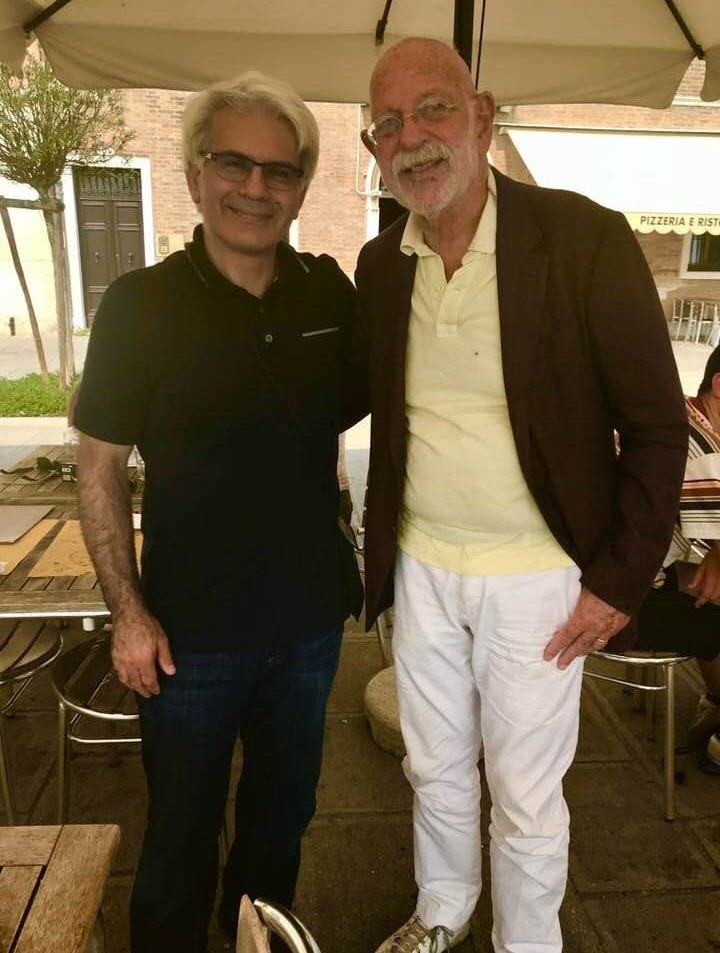
Bruce Liemsidor and author, Venice, 2018
Wonderful story - well worth a chapter in your upcoming book!